Gallery Two · Exhibit 02
Computing on the Kitchen Table
Home computers arrived in kitchens, spare rooms and living rooms long before anyone agreed on what they were for. Families typed, saved, failed and tried again, and a surprising number of today's digital habits began right there, next to the breakfast plates.
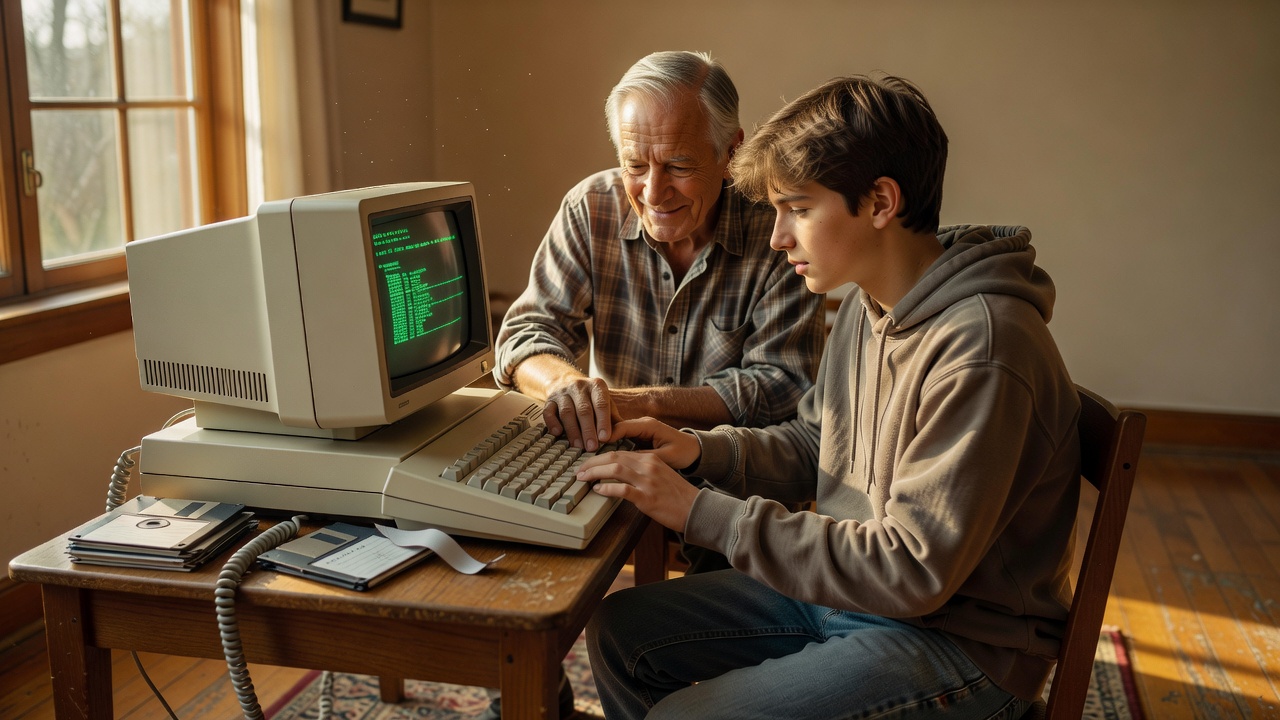
What people actually did with them
It is tempting to remember the first home computers through their specifications, but most owners never experienced a processor speed. They experienced a blinking cursor on the family television, a cassette recorder whose volume had to be set just so, and a thick manual that assumed you wanted to learn to program. In the late 1970s and early 1980s a home computer was an invitation as much as a product. You switched it on and it waited for you to tell it something.
What people told it varied enormously. Children typed in game listings printed in magazines, sometimes hundreds of lines long, and discovered that one misplaced comma could ruin an evening. Parents kept household budgets, catalogued record collections or wrote letters that came out of noisy dot-matrix printers with perforated edges to tear away. Small businesses ran invoices on machines sold in the same shops as toys. Schools used them to teach a curious kind of literacy that blended arithmetic, logic and patience.
Four machines, four kinds of household
The Apple II, released in 1977, brought colour graphics and internal expansion slots into homes and classrooms. When the spreadsheet program VisiCalc appeared for it in 1979, many buyers suddenly had a practical reason to justify the cost: a grid that recalculated itself replaced pages of pencil arithmetic.
In Britain, the BBC Micro, built by Acorn and launched in 1981, was tied to the BBC Computer Literacy Project and its television programmes. It became a fixture of school classrooms, so for many children the computer at home and the computer at school spoke the same dialect of BASIC. The Sinclair ZX Spectrum of 1982 took the opposite approach: small, inexpensive, with rubber keys, it found its way into bedrooms and launched countless amateur game developers.
The Commodore 64, also from 1982, became one of the best-selling single computer models ever made. Its sound chip gave it a musical voice that a devoted community still composes for today.
Documented specification
Commodore 64
- Released
- 1982
- Processor
- MOS Technology 6510, about 1 MHz
- Memory
- 64 KB RAM
- Sound
- SID chip, three voices
- Launch price
- US$595
- Storage
- Datasette tape or 1541 floppy drive
Recollection
Making tea while it loaded
"You could make a cup of tea, drink it, and come back to find LOAD ERROR. Someone at school showed us how to turn the head alignment screw with a jeweller's screwdriver. Nobody's manual mentioned that."
Illustrative composite of commonly shared memories
The ritual of waiting
Loading software from cassette could take several minutes, accompanied by shrieking audio tones and flickering stripes across the screen border. That waiting shaped behaviour. People learned to rewind to exact counter numbers, to write those numbers on cassette inlays, and to keep a spare tape recorder that "liked" a particular game. A failed load was not a mysterious error; it was a physical problem you could reason about: volume, tape stretch, a dirty head.
Today's progress bars and spinning icons inherited the anxiety of waiting while hiding the mechanism. We gained enormous speed and reliability. We lost the sense that the delay had a cause we could see and fix.
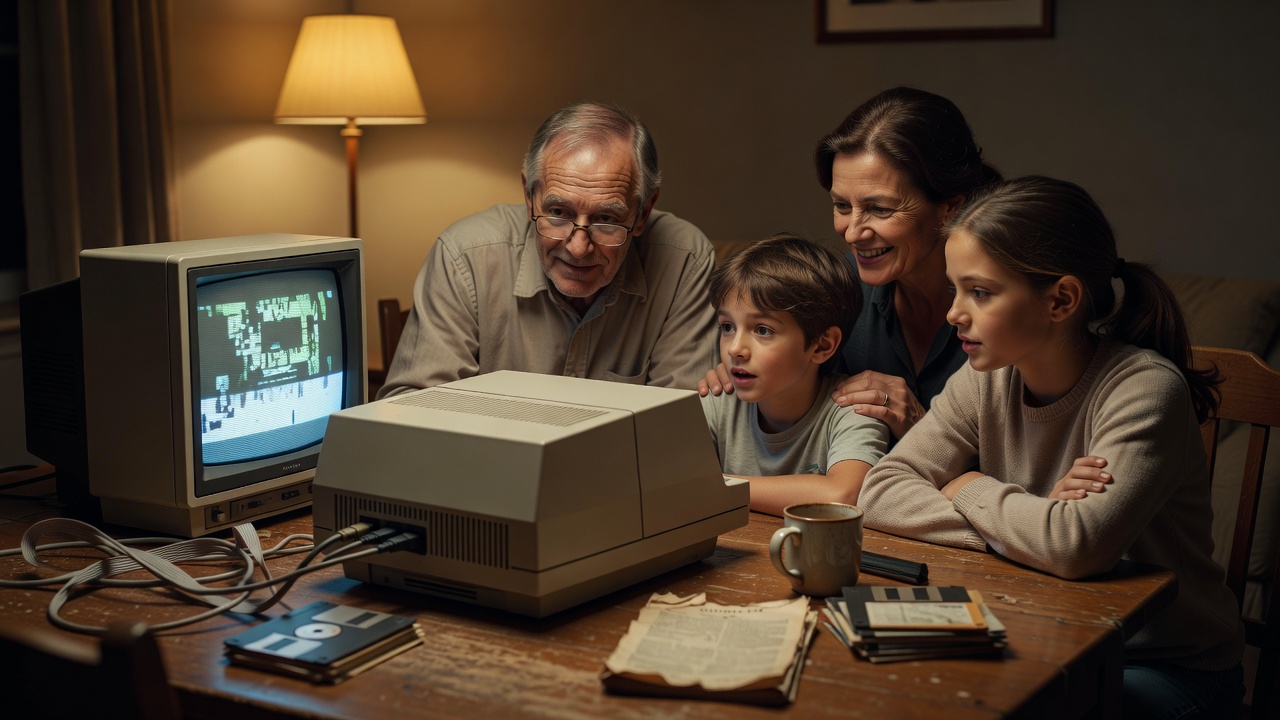
"It felt like the computer belonged to whoever had the patience to sit in front of it that evening."
Recollection · illustrative composite
When home and office met
IBM's Personal Computer, model 5150, launched in August 1981. Its relatively open architecture allowed other manufacturers to build compatible machines, and over the following decade the beige PC clone settled into spare rooms as well as offices. For many households this marked a shift: the computer stopped being a hobby you explored and became a tool you brought work home on. Word processing, spreadsheets and later email gave it a purpose that did not require programming at all.
Inherited and abandoned habits
Several habits from the kitchen-table era are still with us. The family computer prefigured the shared household tablet. Type-in magazine listings anticipated online tutorials, forums and open-source code. Saving your work, and the dread of losing it, became universal.
Other habits were set aside. Modern devices do not greet you with a programming prompt, and manuals no longer print circuit diagrams. That change has real benefits: today's systems are safer, more accessible and usable by people who never wanted to write a line of code. Nostalgia should not convince us that every household secretly longed to program. But something was lost when computers stopped explaining themselves, and it is fair to notice.
Where to see them working
Several institutions keep these machines running for visitors, including The National Museum of Computing at Bletchley Park, the Centre for Computing History in Cambridge and the Computer History Museum in Mountain View, California. Check their own websites for current opening times and hands-on galleries.
Continue the tour
Before the Smartphone
Car phones, pagers, texts and the clamshell snap.
Next galleryTapes, Cartridges and Play
Walkmans, mixtapes and consoles in the living room.
Visit galleryRepairing Digital History
Bench notes, leaking batteries and restoration ethics.
Visit gallery