Gallery Four · Exhibit 04
Tapes, Cartridges and Play
Music and games once arrived as objects you could hold, lend, label and lose. This gallery follows the cassette and the cartridge through bedrooms, buses and living rooms, and asks which of their rituals survived the move to streaming and downloads.
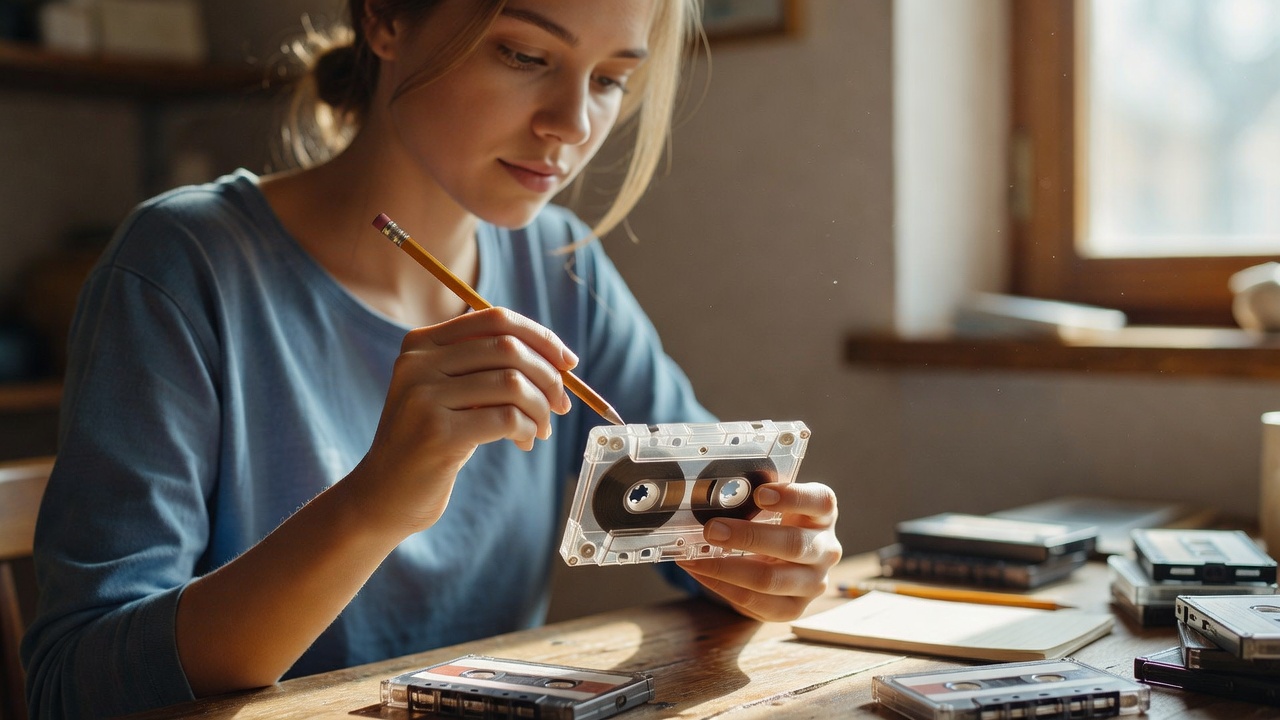
The tape that recorded everything
Philips introduced the Compact Cassette in 1963, originally with dictation and speech in mind. Improvements in tape formulations and noise reduction, notably Dolby B, made it a credible music format by the 1970s. Its decisive feature was not sound quality but the record button. For the first time, ordinary people could easily capture, copy and rearrange music themselves.
So they did. Listeners waited by the radio with fingers on pause and record. Friends dubbed albums on twin-deck stereos. The mixtape became a form of correspondence: an ordered selection, timed to fit a C60 or C90, with a handwritten inlay card. Making one took an evening; receiving one meant someone had spent that evening thinking of you.
Music walks out of the house
Sony's Walkman TPS-L2 went on sale in Japan on 1 July 1979. Early models included two headphone sockets, an implicit suggestion that listening might be shared. Instead, the Walkman became a symbol of private listening in public space, and critics at the time worried about people retreating into personal soundtracks on trains and streets. Those debates sound familiar to anyone who has watched a carriage full of earbuds.
Documented specification
Sony Walkman TPS-L2
- Released
- 1 July 1979, Japan
- Format
- Compact Cassette, playback only
- Power
- Two AA batteries
- Outputs
- Two headphone jacks
Recollection
Rationing the batteries
"Fast-forward drained the batteries, so you learned where songs started by the size of the tape on each spool."
Illustrative composite of commonly shared memories
The television learns to play
The Magnavox Odyssey of 1972, developed from engineer Ralph Baer's prototypes, was the first home video game console. It used plastic overlays taped to the television screen to suggest scenery. In 1977 the Atari Video Computer System, later called the Atari 2600, popularised interchangeable cartridges: one machine, a shelf of games. Families gathered around a single screen, and taking turns became part of the game.
The North American market collapsed in 1983 under a glut of poor-quality titles. Nintendo's Family Computer, launched in Japan in 1983 and released in North America as the Nintendo Entertainment System in 1985, rebuilt confidence partly through strict control of which games reached shelves.
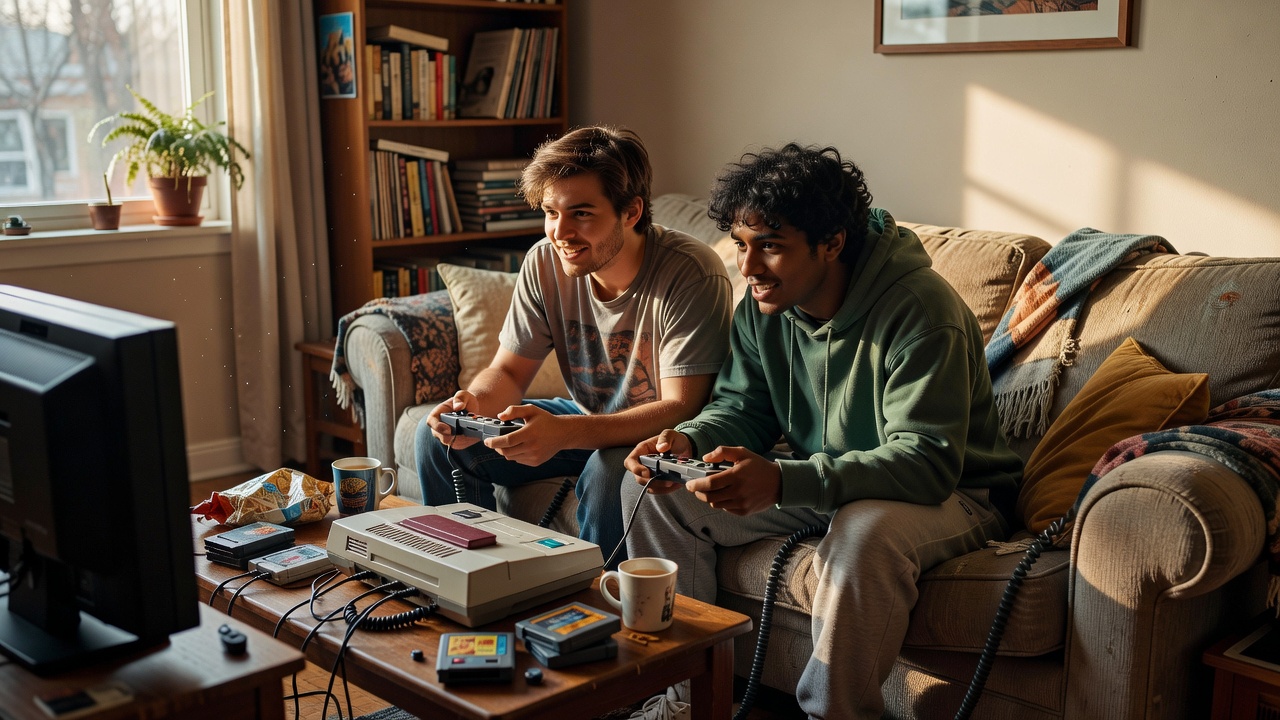
Blowing on cartridges, and other folk remedies
Almost everyone who owned a cartridge console remembers blowing into the connector when a game refused to start. It often seemed to work, but mostly because reinserting the cartridge reseated the contacts. Moisture from breath can, over time, encourage corrosion. Folk remedies like this are a good reminder that shared memories and documented fact are different kinds of evidence, both worth keeping, but not interchangeable.
"Our Game Boy went everywhere: car journeys, dentist waiting rooms, under the duvet with a torch. The battery cover was held on with tape for years."
Recollection · illustrative composite
Play goes portable
Nintendo's Game Boy launched in 1989, bundled in many regions with Tetris. Its green-tinted screen was modest even then, yet its long battery life on four AA cells and its robust build made it a constant companion. A link cable allowed two players to compete, and later trading between friends became central to some games. Many cartridges stored saved games in memory backed by a small coin-cell battery, which means some of those saves are fading now, decades later.
The Strong National Museum of Play in Rochester, New York, home of the World Video Game Hall of Fame, preserves many of these machines and their cultural context.
What streaming kept, and what it dropped
Playlists inherited the mixtape's careful ordering. Portable listening, once a novelty, became the default. Save systems, achievements and online multiplayer grew from cartridges and link cables. What faded was the physical economy of lending: handing a friend a tape, borrowing a game for the weekend, finding someone else's handwriting on an inlay card years later. Digital libraries are larger and more reliable. They are also, mostly, impossible to give away.
Continue the tour
Before the Smartphone
Brick phones, T9 and the clamshell snap.
Previous galleryRepairing Digital History
Belts, batteries and the ethics of the bench.
Next galleryLeave a Museum Note
Share your own tape or cartridge story.
Write a note